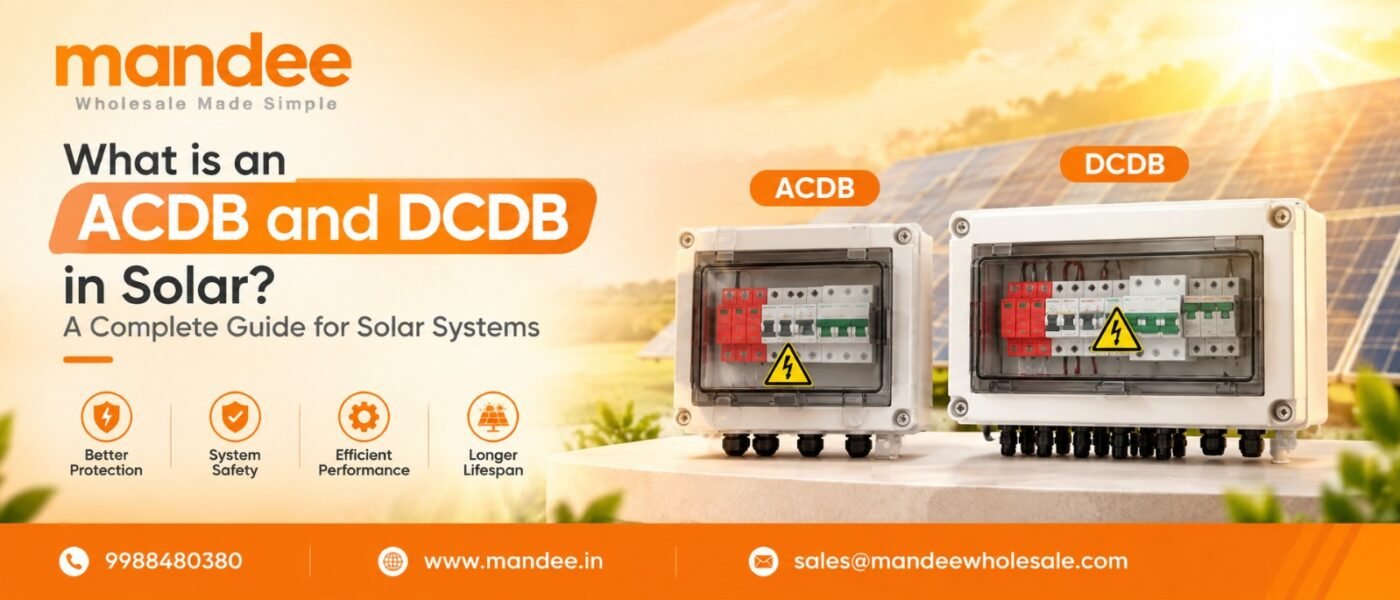
In a solar power system, safety and reliable power distribution are just as important as choosing high-quality solar panels and inverters. Two important protection and distribution components used around the inverter are the ACDB (Alternating Current Distribution Box) and DCDB (Direct Current Distribution Box).
But what exactly do ACDB and DCDB do? Where are they installed? What components do they contain? And how should EPC companies choose the right ACDB and DCDB for a project?
This guide explains ACDB and DCDB in solar systems in simple terms, while also covering their components, functions, differences, selection criteria, installation considerations and procurement tips.
Quick Answer: What Are ACDB and DCDB in Solar?
ACDB stands for Alternating Current Distribution Box. It is installed on the AC side of a solar inverter and helps protect the system and distribute electricity safely from the inverter toward the AC load or grid connection.
DCDB stands for Direct Current Distribution Box. It is installed on the DC side of the solar system, generally between the solar PV array and inverter, to provide DC-side protection, isolation and distribution.
In simple terms:
| Component | Full Form | Side of Solar System | Main Purpose |
|---|---|---|---|
| DCDB | Direct Current Distribution Box | DC side | Protects and isolates electricity coming from solar panels |
| ACDB | Alternating Current Distribution Box | AC side | Protects and distributes electricity coming from the inverter |
| Solar Inverter | — | Between DC & AC | Converts DC electricity into AC electricity |
A simplified solar power flow looks like:
Solar Panels → DCDB → Solar Inverter → ACDB → Grid/Load
What is a DCDB in a Solar System?
A DCDB, or Direct Current Distribution Box, is a protection and distribution enclosure installed on the DC side of a solar PV system.
Solar panels generate DC electricity. Multiple panels are connected into strings, and these strings carry DC power toward the inverter.
The DCDB provides a controlled point for protection, isolation and distribution of DC power before it reaches the inverter.
What does a DCDB do?
A DCDB can help with:
- DC circuit protection
- String protection
- Overcurrent protection
- Surge protection
- DC isolation
- Safe maintenance and troubleshooting
- Combining or distributing multiple PV strings, depending on system design
The exact configuration depends on the size and architecture of the solar installation.
Main Components of a Solar DCDB
A DCDB may contain several protection and switching components.
1. DC Fuse
DC fuses can provide overcurrent protection for PV strings and circuits.
For larger solar installations with multiple strings, appropriately rated PV fuses may be used to protect individual strings.
2. DC MCB or DC Protection Device
Depending on the system design, DC-rated circuit protection devices may be incorporated into the DCDB.
It is important to use devices specifically designed and rated for the DC voltage and current of the PV system.
3. DC Isolator
A DC isolator allows the DC circuit to be disconnected for maintenance, inspection or emergency situations.
The isolator must be appropriately rated for the system voltage, current and number of poles.
4. DC Surge Protection Device
A DC SPD helps protect the solar installation against transient voltage surges, including those associated with lightning events and switching disturbances.
The SPD must be selected according to the PV system’s electrical characteristics and protection design.
5. String Monitoring Components
In larger PV systems, the DC distribution arrangement may include monitoring components that help EPC teams identify string-level problems.
What is an ACDB in a Solar System?
An ACDB, or Alternating Current Distribution Box, is installed on the AC side of the solar inverter.
The solar inverter converts the DC electricity generated by solar panels into AC electricity.
The ACDB then provides a controlled point for AC-side protection, isolation and distribution before electricity is supplied to the building, electrical network or grid connection.
What does an ACDB do?
An ACDB can provide:
- AC circuit protection
- Overcurrent protection
- Surge protection
- Isolation
- Distribution of inverter output
- Protection during electrical faults
- Safe maintenance and inspection
The exact ACDB configuration depends on the inverter output, system voltage, number of phases, installation type and grid interconnection requirements.
Main Components of a Solar ACDB
The components inside an ACDB vary according to project requirements.
Common components include:
1. AC MCCB/MCB
An appropriately rated circuit breaker can provide protection against overloads and short circuits.
For larger solar installations, MCCBs may be used depending on the required current rating and system design.
2. AC Isolator
An AC isolator provides a means of disconnecting the inverter from the downstream AC circuit for maintenance and safety.
3. AC Surge Protection Device
An AC SPD helps protect downstream electrical equipment against transient voltage surges.
4. Busbar
Busbars provide an organized method of distributing electrical power inside the distribution enclosure.
5. Metering or Monitoring Equipment
Depending on the project, ACDBs may accommodate or interface with electrical measurement and monitoring equipment.
ACDB vs DCDB: What is the Difference?
One of the easiest ways to understand ACDB and DCDB is to look at where they are installed and what type of electricity they handle.
| Feature | DCDB | ACDB |
|---|---|---|
| Full Form | Direct Current Distribution Box | Alternating Current Distribution Box |
| Electrical Side | DC | AC |
| Typical Position | Between PV array and inverter | After inverter |
| Current Type | Direct Current | Alternating Current |
| Main Function | DC protection and isolation | AC protection and distribution |
| Typical Protection | DC fuse, DC isolator, DC SPD | MCB/MCCB, AC isolator, AC SPD |
| Connected Equipment | Solar PV strings/inverter | Inverter/load/grid |
| Selection Depends On | PV voltage, current, strings and system design | Inverter output, voltage, current and grid requirements |
The simplest difference
DCDB protects the DC side of the solar system, while ACDB protects and distributes power on the AC side.
Why are ACDB and DCDB Important in Solar Projects?
Solar systems operate with significant electrical voltages and currents. Protection equipment is therefore essential for safe and reliable operation.
A properly designed ACDB and DCDB can help:
1. Improve System Safety
Protection devices provide controlled methods of isolating circuits and responding to electrical faults.
2. Protect Solar Equipment
Appropriately selected protection devices can help reduce the risk of damage caused by overcurrent and transient voltage events.
3. Make Maintenance Easier
Isolators provide a practical method of disconnecting sections of the system during maintenance.
4. Support Reliable Power Distribution
ACDBs and DCDBs organize the connection between major electrical components and downstream circuits.
5. Support EPC Project Compliance
EPC companies need to design electrical protection according to the applicable project specifications, equipment ratings, installation conditions and local requirements.
Where are ACDB and DCDB Installed?
A typical rooftop or ground-mounted solar system may follow this arrangement:
Solar PV Modules
↓
PV Strings
↓
DCDB / DC Protection
↓
Solar Inverter
↓
ACDB / AC Protection
↓
AC Distribution Panel / Load / Grid Connection
The exact arrangement can differ depending on the inverter architecture and project design.
For example, some modern inverters may already include certain DC protection functions. In such cases, an external DCDB configuration may be different or may not be required in the same form.
This is why ACDB and DCDB should always be specified according to the actual solar system design, rather than using a standard box for every project.
How to Choose the Right DCDB for a Solar Project
For EPC companies, selecting a DCDB is not simply about finding the lowest-priced product.
Several electrical and environmental factors should be evaluated.
1. Check Maximum DC Voltage
The DCDB should be appropriately rated for the maximum system voltage.
For example, the voltage characteristics of a 1000 V or 1500 V PV system require compatible DC protection equipment.
Always verify the actual maximum system voltage before selecting the enclosure and protection devices.
2. Check Current Rating
The expected operating current and fault conditions should be considered while selecting fuses, isolators, busbars and other components.
3. Determine the Number of Strings
The number of PV strings directly affects the configuration of the DC distribution arrangement.
An EPC company should determine:
- Number of PV strings
- String current
- Number of inputs
- Number of outputs
- Required string protection
- Inverter input configuration
4. Select the Appropriate SPD
The DC SPD should be selected according to the PV system voltage and the overall lightning and surge protection strategy.
5. Check Enclosure Protection
For rooftop and outdoor installations, the enclosure needs suitable environmental protection.
Factors can include:
- Dust
- Rain
- Humidity
- Temperature
- UV exposure
- Corrosion
- Installation location
How to Choose the Right ACDB
The ACDB should be matched with the inverter and the downstream electrical system.
Important parameters include:
- Inverter AC output
- System voltage
- Single-phase or three-phase configuration
- Rated current
- Short-circuit requirements
- Number of inverter outputs
- Breaker rating
- SPD requirements
- Cable size
- Enclosure protection
- Indoor or outdoor installation
- Grid interconnection requirements
For larger projects, EPC engineers should also consider the overall protection coordination and fault-level requirements rather than selecting components independently.
ACDB and DCDB Selection: What EPC Companies Should Check
If you are an EPC company procuring solar equipment, ask the supplier for complete technical specifications.
ACDB checklist
- AC voltage rating
- Current rating
- Number of inputs and outputs
- MCB/MCCB specifications
- AC SPD specifications
- Isolator rating
- Busbar rating
- Enclosure material
- IP protection rating
- Applicable test reports/certifications
- Warranty
- Project-specific customization
DCDB checklist
- Maximum DC voltage
- Current rating
- Number of strings
- DC fuse rating
- DC isolator rating
- DC SPD rating
- Number of inputs/outputs
- Enclosure protection
- Cable entry arrangement
- Earthing provision
- Applicable test reports/certifications
- Warranty
ACDB and DCDB: Buy Ready-Made or Customized?
The answer depends on the project.
For smaller installations, a standard configuration may be sufficient if it meets the project’s technical requirements.
For commercial, industrial and utility-scale solar projects, customized ACDB and DCDB solutions may be more appropriate.
Customization can include:
- Number of inputs
- Number of outputs
- Protection devices
- Busbar configuration
- Metering
- SPD configuration
- Enclosure dimensions
- Cable entry
- Monitoring
- Labeling
- Project-specific requirements
The key is to select the configuration based on the electrical design, not simply the physical size of the box.
ACDB and DCDB as Part of Solar EPC Materials
For an EPC company, ACDB and DCDB are only two parts of the overall solar procurement requirement.
A typical solar project may require:
- Solar panels
- Solar inverters
- ACDB
- DCDB
- Solar DC cables
- AC cables
- MC4-compatible connectors
- Earthing equipment
- Lightning protection
- Mounting structures
- Solar cable accessories
- Junction boxes
- Monitoring equipment
- Other balance-of-system components
This makes it important to work with a reliable solar EPC material supplier that can support multiple project requirements.
How to Find a Reliable Solar Products Supplier
Whether you are looking for ACDB, DCDB, solar panels, inverters, cables or other components, supplier evaluation should go beyond price.
A reliable solar products supplier should ideally provide:
Technical Product Information
Product datasheets should clearly specify electrical ratings, protection devices and applicable specifications.
Consistent Product Quality
Solar protection equipment should be suitable for the intended application and system design.
Transparent Pricing
For EPC procurement, compare the complete supply cost rather than only the unit price.
Product Availability
For project execution, delays in critical components can affect installation schedules.
After-Sales Support
Technical assistance, warranty support and replacement processes can be important for long-term projects.
Solar Products Wholesale for EPC Companies
For companies purchasing equipment in larger quantities, solar products wholesale procurement can provide operational advantages.
Instead of sourcing every component separately, EPC companies can evaluate a solar wholesale supplier based on:
- Product range
- Bulk pricing
- Stock availability
- Delivery capability
- Technical support
- Warranty
- Product documentation
- Supplier reliability
When purchasing solar products wholesale in India, project requirements and delivery locations should be considered along with the quoted price.
How to Get the Best Price from a Solar EPC Material Supplier in India
Searching for a solar EPC material supplier best price India is common among EPC companies.
However, the cheapest quotation is not necessarily the lowest overall project cost.
Compare the total value of the quotation.
Consider:
Product Cost + Shipping + Installation Compatibility + Warranty + Replacement Support + Delivery Time
A low-priced ACDB with unsuitable protection devices could ultimately cost more if it results in project delays or equipment issues.
Practical procurement tip
Request quotations using a standardized technical specification sheet.
This makes it easier to compare suppliers on a like-for-like basis.
Can You Buy Solar Products Online?
Yes, EPC companies and solar businesses can use online B2B marketplaces to research and source different types of solar products.
If you want to buy solar products online, compare:
- Technical specifications
- Manufacturer
- Product ratings
- Quantity
- MOQ
- Warranty
- Delivery location
- Supplier information
- Applicable certifications/test documents
- Final landed price
Online procurement can be particularly useful when sourcing wholesale solar products across different locations in India.
Why Supplier Selection Matters for Solar EPC Projects
Choosing the right solar equipment supplier India can have a direct impact on project execution.
An EPC company may need a supplier capable of providing:
Panels + Inverters + ACDB + DCDB + Cables + Mounting Structures + Other Solar Components
This is where a dependable solar component supplier can simplify procurement.
Instead of managing multiple vendors for every component, EPC companies can evaluate suppliers based on their ability to support the complete project requirement.
Solar Distributor vs Solar Supplier: What’s the Difference?
The terms solar distributor, solar supplier and solar products distributor are often used interchangeably, but they can represent different roles in the supply chain.
A manufacturer produces the equipment.
A distributor generally purchases products from manufacturers and supplies them to dealers, EPC companies or other businesses.
A supplier is a broader term that can refer to a company supplying products to customers, whether directly from manufacturing, distribution or wholesale channels.
For an EPC company, the most important question is:
Can the supplier provide the right product, quantity, specifications, pricing and support when the project needs it?
Common Mistakes When Buying ACDB and DCDB
1. Choosing Only on Price
A low price should never replace technical evaluation.
2. Ignoring Voltage Ratings
The protection device must be suitable for the actual system voltage.
3. Using AC Equipment on DC Circuits
AC and DC protection devices are not automatically interchangeable.
4. Ignoring Environmental Conditions
Outdoor solar installations need equipment suitable for the installation environment.
5. Not Checking Product Documentation
Always request technical datasheets and relevant test/certification documents.
6. Not Considering Future Maintenance
Proper isolation and labeling can make troubleshooting significantly easier.
7. Ordering Before Finalizing the Electrical Design
The ACDB/DCDB configuration should match the final inverter, string and electrical protection design.
ACDB and DCDB FAQs
1. What is ACDB in solar?
ACDB stands for Alternating Current Distribution Box. It is installed on the AC side of a solar inverter to provide protection, isolation and distribution of AC power.
2. What is DCDB in solar?
DCDB stands for Direct Current Distribution Box. It is used on the DC side of a solar PV system to provide functions such as DC protection, isolation and string distribution.
3. Is DCDB required in every solar system?
Not necessarily. The requirement and configuration depend on the system architecture, inverter design and project specifications. Some inverters include certain DC protection functions internally.
4. Is ACDB required in every solar system?
The need for a separate ACDB depends on the system design, inverter configuration, electrical installation and applicable requirements.
5. What is the difference between ACDB and DCDB?
The primary difference is the type of electricity they handle. DCDB is used on the DC side of the solar system, while ACDB is used on the AC side.
6. What components are used in a DCDB?
Depending on the design, a DCDB can include DC fuses, DC isolators, surge protection devices, terminals, busbars and other protection or monitoring components.
7. What components are used in an ACDB?
An ACDB can include MCBs/MCCBs, AC isolators, surge protection devices, busbars, terminals and metering or monitoring components, depending on project requirements.
8. How do I select an ACDB for a solar project?
Consider the inverter output, AC voltage, current, phase configuration, protection requirements, short-circuit conditions, SPD requirements, enclosure protection and applicable project specifications.
9. How do I select a DCDB?
Consider the maximum PV voltage, string current, number of strings, fuse requirements, isolator rating, SPD requirements, enclosure protection and inverter input configuration.
10. Where can EPC companies source ACDB and DCDB?
EPC companies can source ACDB, DCDB and other solar components through manufacturers, distributors, wholesalers and B2B solar marketplaces. The supplier should be evaluated based on technical suitability, documentation, pricing, availability and support.
Final Takeaway
ACDB and DCDB are important protection and distribution components in many solar PV installations.
The DCDB operates on the DC side, helping protect and isolate power coming from the solar PV array, while the ACDB operates on the AC side, helping protect and distribute power from the inverter.
For EPC companies, the right selection should be based on system voltage, current, inverter configuration, number of strings, protection requirements, environmental conditions and project specifications.
Whether you are sourcing ACDBs, DCDBs, solar panels, inverters, cables or other solar products, don’t evaluate suppliers on price alone. A reliable solar material supplier India should be able to provide technically suitable products, transparent specifications, dependable supply and appropriate support.