Choosing the right solar inverter is one of the most important decisions when planning a solar power system. While solar panels generate electricity from sunlight, the inverter converts that electricity into usable power for homes, businesses, and industrial applications.
But not every solar inverter works in the same way.
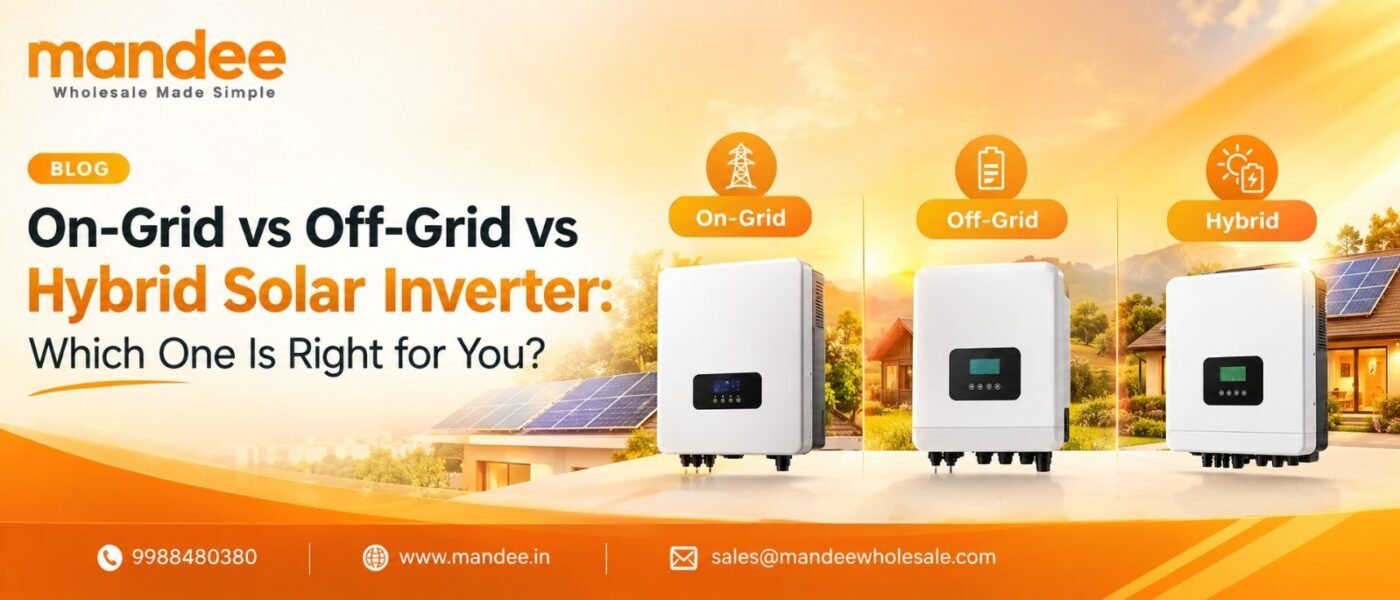
The three most common options are on-grid, off-grid, and hybrid solar inverters. Each has a different operating mechanism, cost structure, backup capability, and ideal use case.
Whether you are a homeowner, solar installer, EPC company, or looking for a reliable solar products supplier, understanding these differences can help you select the right equipment for your project.
In this guide, we explain on-grid vs off-grid vs hybrid solar inverters, their advantages and limitations, applications, and the factors to consider before purchasing.
What is a Solar Inverter?
A solar inverter is an essential component of a solar power system. Solar panels generate electricity in DC (direct current), while most household and commercial appliances operate on AC (alternating current).
The inverter converts DC electricity generated by the solar panels into AC electricity that can be used by electrical loads.
Depending on the system design, an inverter may also:
- Send excess solar electricity to the grid
- Charge batteries
- Provide backup power
- Manage solar generation and energy consumption
- Monitor system performance
- Control power flow between solar panels, batteries, loads, and the grid
This is why selecting the right inverter is just as important as selecting quality solar panels and other system components.
On-Grid vs Off-Grid vs Hybrid Solar Inverter
The simplest way to understand the difference is:
| Feature | On-Grid Inverter | Off-Grid Inverter | Hybrid Inverter |
|---|---|---|---|
| Grid connection | Yes | Usually no | Yes |
| Battery required | No | Yes | Optional/usually supported |
| Backup during grid outage | No | Yes | Yes |
| Excess solar export | Yes | No | Yes, depending on configuration |
| Battery charging | No | Yes | Yes |
| Typical application | Homes & businesses with reliable grid | Remote/off-grid locations | Homes & businesses needing flexibility |
| Initial cost | Lower | Moderate | Higher |
| Best for | Reducing electricity bills | Energy independence | Solar + grid + battery management |
Let’s look at each option in detail.
1. What is an On-Grid Solar Inverter?
An on-grid solar inverter, also called a grid-tied inverter, is designed to work alongside the utility electricity grid.
Solar panels generate electricity during the day, and the inverter converts it into AC electricity for use in the building.
If the solar system generates more electricity than the property needs, the surplus can potentially be exported to the electricity grid under the applicable net-metering or other grid-interconnection framework.
How an On-Grid Solar System Works
The basic flow is:
Solar Panels → On-Grid Inverter → Home/Business Loads → Electricity Grid
During sunny hours, solar power can reduce the amount of electricity purchased from the grid.
However, one important point is that most standard grid-tied systems shut down when the grid goes off. This is a safety feature designed to prevent electricity from being fed into a grid that may be undergoing maintenance.
Advantages of On-Grid Inverters
- Lower system cost compared with battery-based systems
- No battery replacement requirement
- Helps reduce electricity bills
- Can make use of surplus solar generation through permitted grid export
- Suitable for properties with reliable grid electricity
- Generally simpler system architecture
Limitations
The biggest limitation is backup power.
If the utility grid fails, a conventional on-grid inverter normally stops supplying electricity, even if the solar panels are producing power.
Who Should Choose an On-Grid Inverter?
An on-grid inverter may be suitable for:
- Urban homes
- Offices
- Shops
- Commercial buildings
- Factories
- Educational institutions
- Businesses with reliable grid supply
If your primary objective is reducing electricity costs rather than having backup power, an on-grid system can be an economical choice.
2. What Is an Off-Grid Solar Inverter?
An off-grid solar inverter is designed for systems that operate independently of the utility electricity grid.
These systems typically combine:
- Solar panels
- Solar inverter
- Battery bank
- Electrical loads
- Charge controller, where required depending on the system architecture
How an Off-Grid Solar System Works
A simplified configuration is:
Solar Panels → Solar Inverter/Charge System → Battery + Loads
Solar energy can power appliances during the day while excess energy may be stored in batteries for use later.
Because the system does not depend on the electricity grid, it can be useful in remote locations where grid electricity is unavailable or unreliable.
Advantages of Off-Grid Inverters
- Provides backup power
- Can operate without a utility grid
- Suitable for remote locations
- Helps reduce dependence on grid electricity
- Can provide energy independence when properly designed
Limitations
Battery storage increases the overall system cost.
The battery also has a finite lifespan and needs appropriate sizing, maintenance, and eventual replacement.
An off-grid system must therefore be carefully designed according to:
- Daily electricity consumption
- Peak load
- Solar generation
- Battery capacity
- Backup requirement
- Seasonal sunlight availability
Who Should Choose an Off-Grid Inverter?
Off-grid systems can be useful for:
Locations without reliable grid access
Remote homes
Rural properties
Agricultural applications
Telecom sites
Remote offices
Farmhouses
3. What Is a Hybrid Solar Inverter?
A hybrid solar inverter combines features of grid-connected and battery-based solar systems.
It can coordinate power from:
- Solar panels
- Batteries
- Utility grid
- Electrical loads
Depending on the inverter and system configuration, it can prioritize solar energy, charge batteries, draw power from the grid when required, and provide backup during outages.
How a Hybrid Solar System Works
A simplified flow is:
Solar Panels ↔ Hybrid Inverter ↔ Battery
Hybrid Inverter ↔ Grid
Hybrid Inverter → Electrical Loads
This gives users greater flexibility in managing their energy.
For example, solar power can be used to run appliances during the day while surplus generation charges the battery. Stored energy can then be used when solar generation is unavailable.
Advantages of Hybrid Inverters
- Supports solar + battery + grid integration
- Can provide backup power
- Better energy management flexibility
- Can increase the use of self-generated solar electricity
- Suitable for locations with unreliable grid supply
- Can support different energy-management strategies
Limitations
- Higher initial investment
- More complex installation
- Battery adds to the system cost
- Requires proper system sizing and configuration
Who Should Choose a Hybrid Inverter?
Hybrid inverters can be particularly useful for:
Businesses looking to combine solar generation with battery storage
Homes experiencing frequent power cuts
Commercial establishments
Offices
Shops
Small industries
On-Grid vs Off-Grid vs Hybrid: Key Differences
When comparing the three inverter types, the biggest difference is how they interact with the grid and battery storage.
On-Grid
The focus is on solar generation + grid interaction.
Off-Grid
The focus is on solar generation + battery storage + energy independence.
Hybrid
The focus is on solar + battery + grid flexibility.
Therefore, there is no single inverter that is best for everyone.
The right choice depends on your electricity consumption, grid reliability, budget, backup requirements, and long-term energy goals.
How to Choose the Right Solar Inverter?
Before purchasing an inverter, consider the following factors.
1. Electricity Consumption
Start by understanding how much electricity your home or business consumes.
Check your electricity bills and identify:
- Monthly consumption
- Daily consumption
- Peak load
- Daytime consumption
- Night-time consumption
This helps determine the appropriate solar and inverter capacity.
2. Grid Availability
If your location has reliable electricity supply, an on-grid inverter may be sufficient.
If electricity outages are frequent, consider an inverter that supports battery backup.
For areas without reliable grid access, an off-grid system may be more appropriate.
3. Backup Power Requirement
Ask yourself a simple question:
Do I need solar power to continue operating during a grid outage?
If the answer is yes, a conventional on-grid inverter may not be sufficient.
You may need an off-grid or suitable hybrid configuration.
4. Battery Requirement
Batteries can significantly increase the initial investment.
If you don’t need backup power, an on-grid system without batteries may be more economical.
If energy storage is important, compare battery-compatible off-grid and hybrid inverter solutions.
5. Budget
Cost should not be the only consideration.
Compare the complete system cost, including:
- Solar panels
- Inverter
- Batteries
- Mounting structures
- Cables
- Protection devices
- Installation
- Monitoring equipment
- Maintenance
A lower inverter price does not necessarily mean a lower total system cost.
Buying Solar Inverters and Other Solar Products
Choosing the right inverter is only one part of building a reliable solar system.
You may also need:
- Solar panels
- Solar inverters
- Mounting structures
- DC cables
- AC cables
- Connectors
- DCDB
- ACDB
- Earthing equipment
- Protection devices
- Batteries
- Monitoring systems
- Other BOS components
For EPC companies, installers, distributors, and businesses, sourcing these products from a reliable solar products supplier can simplify procurement.
A good solar equipment supplier India should ideally offer product availability, technical information, quality assurance, competitive pricing, and dependable delivery.
How to Choose a Solar Products Supplier in India?
Whether you are looking for solar products wholesale India or project-specific procurement, evaluate your supplier carefully.
Check Product Range
A supplier should ideally provide a broad range of solar products and components.
Evaluate Product Quality
Check product specifications, certifications, warranty terms, and manufacturer information.
Compare Pricing
Businesses should compare pricing from multiple suppliers rather than selecting a product based only on the lowest quoted price.
Check Availability
For EPC projects, delays in component supply can affect project timelines.
Evaluate Technical Support
Technical assistance can be valuable when selecting inverter capacity, compatibility, and system components.
Consider Delivery Capability
For larger projects, confirm whether the supplier can deliver products according to your project schedule.
Solar Components Wholesale for EPC Companies
EPC companies often require multiple components for every project.
Instead of purchasing each component separately, working with a reliable solar components supplier India can simplify procurement.
A professional solar EPC material supplier India may supply products such as:
- Solar modules
- Inverters
- Cables
- Connectors
- Structures
- Electrical protection equipment
- Batteries
- BOS components
For large projects, buyers may also search for a solar EPC material supplier best price India to balance cost, quality, availability, and delivery timelines.
The objective should not simply be the lowest price. The better approach is to evaluate total procurement value.
Wholesale Solar Products vs Retail Solar Products
The purchasing model can differ depending on the buyer.
Retail Buyers
Homeowners may purchase products based on:
- System size
- Product quality
- Warranty
- Installation support
- Local service
Wholesale Buyers
Installers, distributors, EPC companies, and resellers may focus more on:
- Bulk pricing
- Product availability
- Consistent quality
- Logistics
- Credit/payment terms
- Technical support
- Warranty handling
A solar wholesale supplier can therefore be particularly useful for businesses purchasing solar equipment in larger quantities.
Can You Buy Solar Products Online?
Yes. Many solar products can be researched and purchased through online B2B marketplaces and supplier platforms.
When you buy solar products online, don’t evaluate the product solely by its displayed price.
Check:
- Product specifications
- Brand/manufacturer
- Warranty
- Certifications
- Compatibility
- Seller information
- Quantity availability
- Shipping terms
- Return/replacement policy
- Technical support
This is particularly important when purchasing high-value solar equipment.
Role of a Solar Distributor in India
A solar distributor India can connect manufacturers with installers, EPC companies, retailers, and other businesses.
Distributors can play an important role in:
- Product availability
- Bulk procurement
- Regional distribution
- Inventory management
- Technical assistance
- Logistics
- After-sales support
For businesses, working with an established solar products distributor can make procurement easier, especially when multiple components are required for recurring projects.
On-Grid vs Off-Grid vs Hybrid: Which One Should You Choose?
There is no universal answer.
Choose On-Grid If:
- You have reliable grid electricity
- Your primary goal is reducing electricity bills
- You don’t require backup during outages
- You want a comparatively simpler system
Choose Off-Grid If:
- Grid electricity is unavailable or unreliable
- You need independent power
- Battery storage is essential
- You are installing solar in a remote location
Choose Hybrid If:
You want to increase solar self-consumption
You want solar + battery + grid integration
Backup power is important
You want greater energy-management flexibility
Final Thoughts
The choice between an on-grid, off-grid, and hybrid solar inverter depends on how you generate, use, store, and manage electricity.
An on-grid inverter can be an effective option for reducing electricity bills where grid supply is reliable. An off-grid inverter is better suited to independent solar systems that rely on battery storage. A hybrid inverter offers greater flexibility by combining solar, batteries, and the electricity grid.
For EPC companies, installers, distributors, and businesses, selecting the inverter is only one part of the procurement process. Working with a dependable solar material supplier India or solar supplier India can help ensure that the inverter and other system components are compatible, available, and suitable for the project.
The best approach is to evaluate the complete system—not just the inverter price—before making a purchasing decision.
Frequently Asked Questions
1. What is the difference between on-grid, off-grid, and hybrid solar inverters?
An on-grid inverter works with the utility grid, an off-grid inverter operates independently using battery storage, and a hybrid inverter can integrate solar, batteries, and the grid.
2. Which solar inverter is best for a home?
It depends on your requirements. On-grid systems can be suitable for homes with reliable grid electricity and no backup requirement, while hybrid systems may be better when backup power is important.
3. Does an on-grid inverter work during a power cut?
Normally, a conventional grid-tied inverter shuts down during a grid outage. Backup requires an appropriately designed system with suitable backup equipment.
4. Is a hybrid inverter better than an on-grid inverter?
Not necessarily. A hybrid inverter offers more functionality, particularly battery storage and backup capability, but it generally costs more. The right choice depends on your requirements.
5. Do off-grid solar systems need batteries?
Yes, battery storage is typically an essential part of an off-grid system because there is no utility grid available to supply electricity when solar generation is insufficient.
6. Are hybrid solar inverters more expensive?
Generally, hybrid systems can cost more than basic on-grid systems because they support additional functionality and may include battery storage.
7. What should I check before buying a solar inverter?
Check inverter capacity, efficiency, operating voltage range, compatibility with your solar panels and batteries, warranty, protection features, monitoring capabilities, certifications, and after-sales support.
8. Where can businesses buy solar products in bulk?
Businesses can source products through manufacturers, distributors, B2B marketplaces, and established solar products wholesale suppliers. Compare product quality, pricing, availability, warranty, and delivery capabilities before purchasing.