Installing a rooftop solar system is a significant investment. While most buyers naturally focus on solar panels, the solar inverter is equally important. It converts the electricity generated by your solar panels into usable power for your home, business or facility.
Choosing the wrong inverter can affect system performance, energy generation, safety and long-term operating costs. The right inverter, on the other hand, can help your rooftop solar system operate efficiently for years.
But with different inverter technologies, capacities, features and price points available in the market, how do you know which one is right for your project?
This guide explains how to choose the right solar inverter for a rooftop system, what specifications to compare, how to calculate inverter capacity and what buyers should check before purchasing.
What is a Solar Inverter?
A solar inverter is an essential component of a solar power system. Solar panels generate electricity in the form of direct current (DC), while most homes, offices and commercial facilities use alternating current (AC).
The inverter converts DC electricity from the solar panels into AC electricity that can be used by electrical appliances or supplied to the grid, depending on the type of solar system.
Modern inverters can also provide functions such as:
- Solar energy monitoring
- Maximum Power Point Tracking (MPPT)
- Grid synchronization
- System protection
- Fault detection
- Performance monitoring
- Remote monitoring
- Battery management in hybrid systems
Because the inverter directly affects how efficiently solar energy is converted and used, selecting the right model should be an important part of your rooftop solar planning.
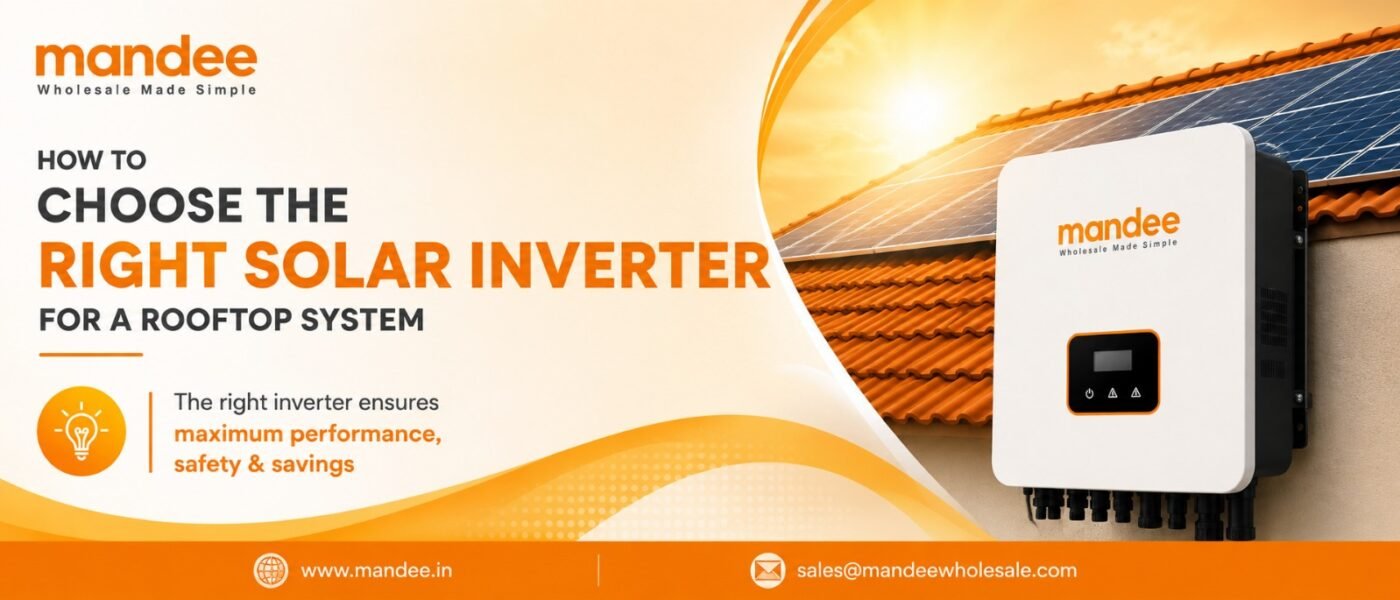
How to choose the right solar inverter for a rooftop system.
Why Choosing the Right Solar Inverter Matters
Solar panels and inverters work as a system. Even if you install high-efficiency panels, an unsuitable inverter can limit the overall performance of the installation.
The right inverter can help with:
Better energy conversion:
A high-quality inverter efficiently converts the DC electricity generated by the panels into usable AC electricity.
Improved system reliability:
A suitable inverter is designed to handle the electrical characteristics and operating conditions of the solar array.
Better monitoring:
Many modern inverters provide real-time information about solar generation, system performance and faults.
Long-term value:
The inverter is a long-term component of a rooftop system, so selecting a reliable product can reduce maintenance and replacement concerns.
Types of Solar Inverters for Rooftop Systems
Before choosing an inverter, understand the main types available.
1. String Inverter
A string inverter connects multiple solar panels arranged in one or more strings.
It is widely used for residential and commercial rooftop applications because of its relatively simple installation and maintenance.
Advantages
- Suitable for many rooftop installations
- Relatively simple system design
- Easy maintenance
- Cost-effective for many applications
- Good option where panels receive similar sunlight
Limitations
If some panels experience shading, the performance of the associated string can be affected depending on the system design.
2. Microinverter
With microinverters, an inverter is installed at the individual panel level rather than using one central string inverter.
This configuration can be useful where rooftops have multiple orientations, partial shading or complex layouts.
Advantages
- Panel-level conversion
- Useful for complex rooftops
- Better flexibility for certain shading conditions
- Panel-level monitoring in many systems
Limitations
- Higher upfront equipment cost in many applications
- More individual components to install
- Maintenance access may be more complicated depending on installation
3. Hybrid Inverter
A hybrid inverter combines solar generation with battery storage.
It can manage electricity from solar panels, batteries and the grid depending on the system configuration.
Hybrid inverters can be considered when energy storage, backup power or greater energy management flexibility is required.
Suitable for:
- Homes requiring battery backup
- Businesses looking for energy storage
- Areas experiencing grid interruptions
- Solar-plus-storage projects
4. Central Inverter
Central inverters are generally associated with larger solar installations rather than typical residential rooftops.
They can be appropriate for larger commercial or industrial applications where the system design and power capacity justify their use.
For a standard rooftop installation, however, a string or hybrid inverter may often be more practical depending on the project requirements.
How to Choose the Right Solar Inverter for Your Rooftop System
Selecting an inverter should not be based solely on price. Consider the complete solar system, electricity requirements and site conditions.
Here are the most important factors to evaluate.
1. Determine the Solar System Capacity
The first step is understanding the size of your rooftop solar system.
For example, a rooftop system may be designed around:
- 3 kW
- 5 kW
- 10 kW
- 20 kW
- 50 kW
- 100 kW or more
The inverter capacity should be compatible with the solar array and electrical requirements.
Do not simply select an inverter based on the number printed on the product. Your EPC installer or system designer should consider the panel configuration, expected generation, voltage and current ranges and applicable design practices.
2. Check DC-to-AC Sizing
Solar systems are often designed with a DC solar array that is somewhat larger than the inverter’s AC rating.
For example, a solar installation could have a 10 kW DC panel capacity paired with an inverter with a lower AC rating, depending on the manufacturer’s specifications and system design.
This approach can improve inverter utilization because solar panels rarely operate at their maximum rated output throughout the entire day.
However, the acceptable DC-to-AC ratio depends on:
- Inverter specifications
- Panel characteristics
- Local climate
- Roof orientation
- Tilt angle
- Expected solar irradiation
- System design
Always stay within the manufacturer’s permitted DC input limits.
3. Check Maximum DC Voltage
This is one of the most important technical specifications.
The combined voltage of panels connected in a string must remain within the inverter’s permitted operating range.
If the string voltage exceeds the inverter’s maximum DC voltage, it can create serious safety and equipment risks.
The EPC designer should calculate the string configuration based on:
- Panel open-circuit voltage
- Temperature variation
- Number of panels per string
- Inverter maximum DC voltage
- MPPT operating range
This calculation should never be based only on the panel’s nominal voltage.
4. Check MPPT Range and Number of MPPTs
MPPT stands for Maximum Power Point Tracking.
An MPPT helps the inverter extract available power from the solar array under changing operating conditions.
The number of MPPT inputs can become particularly important when the rooftop has:
- Multiple roof orientations
- Different panel groups
- Partial shading
- Different string configurations
For example, if panels are installed on two significantly different roof orientations, having multiple MPPT trackers can provide greater design flexibility.
5. Consider Rooftop Shading
Shading can significantly affect solar generation.
Trees, nearby buildings, water tanks, parapet walls, antennas and other structures can create shadows across panels.
If your rooftop has substantial shading, discuss whether a string inverter with an appropriate MPPT configuration, module-level electronics or microinverters would be more suitable.
The correct solution depends on the site’s actual shading pattern.
6. Look at Inverter Efficiency
Efficiency indicates how effectively the inverter converts DC electricity into AC electricity.
A small efficiency difference may appear insignificant, but over years of operation it can affect total energy production.
When comparing models, look at the manufacturer’s stated efficiency figures and understand whether they refer to maximum efficiency or another standardized efficiency measurement.
Do not evaluate efficiency in isolation. Reliability, operating range, warranty and service support also matter.
7. Check Protection Features
A good rooftop solar inverter should provide appropriate protection features based on the system design.
Depending on the model, these may include:
- Overvoltage protection
- Overcurrent protection
- Short-circuit protection
- Over-temperature protection
- Anti-islanding protection
- Surge protection
- DC and AC monitoring
The exact protection functions vary between manufacturers and models.
Before purchasing, review the technical datasheet rather than relying only on marketing descriptions.
On-Grid, Off-Grid or Hybrid: Which Inverter Should You Choose?
The right inverter also depends on how you intend to use your solar system.
| System Type | Typical Requirement | Suitable Inverter Type |
|---|---|---|
| On-grid rooftop | Solar + utility grid | Grid-tied inverter |
| Off-grid system | Solar + battery | Off-grid inverter |
| Solar + battery backup | Solar + grid + battery | Hybrid inverter |
| Large commercial system | Higher-capacity solar generation | String or central inverter depending on design |
On-Grid Solar
An on-grid system operates alongside the electricity grid. It is commonly used where the objective is to generate solar electricity and reduce grid electricity consumption.
Off-Grid Solar
An off-grid system operates independently from the utility grid and generally requires battery storage.
Hybrid Solar
A hybrid system combines solar generation with battery storage and grid connectivity.
The choice should therefore be based on your energy requirements, grid availability, backup requirements and project economics.
How to Match Solar Panels With an Inverter
The inverter should be compatible with the electrical characteristics of the solar panels.
Before purchasing, compare:
- Panel power rating
- Voc — Open-circuit voltage
- Vmp — Voltage at maximum power
- Isc — Short-circuit current
- Imp — Current at maximum power
- Maximum inverter DC voltage
- MPPT voltage range
- Maximum input current
- Number of MPPTs
A professional system designer should verify these values before finalizing the string configuration.
What Should You Check Before Buying a Solar Inverter?
Whether you are a homeowner, commercial buyer, EPC contractor or procurement professional, use this checklist before purchasing.
Solar Inverter Buying Checklist
1. Capacity
Is the inverter appropriately sized for the solar array?
2. Input voltage
Does the panel string voltage remain within the inverter’s permitted range?
3. Input current
Can the inverter safely handle the current generated by the selected panels?
4. MPPT configuration
Does the inverter have enough MPPTs for the rooftop layout?
5. Efficiency
Compare the manufacturer’s efficiency specifications.
6. Protection
Review the available electrical and safety protection features.
7. Monitoring
Check whether the inverter supports local or remote monitoring.
8. Warranty
Understand the product warranty and applicable terms.
9. Service support
Availability of technical assistance and replacement support is important.
10. Manufacturer documentation
Always request the official technical datasheet and installation documentation.
Should You Buy a Solar Inverter Based on Price?
Price is important, but it should not be the only deciding factor.
A cheaper inverter may appear attractive initially, but the total value of the product depends on its:
- Efficiency
- Reliability
- Warranty
- Monitoring capabilities
- Protection features
- Service support
- Compatibility with the solar panels
- Expected operating conditions
For EPC companies, purchasing decisions should also consider product availability, delivery timelines, technical support and consistency across multiple projects.
This is where working with a reliable solar equipment supplier or solar component supplier can simplify procurement.
How to Choose a Reliable Solar Inverter Supplier in India
Finding the right product is only part of the buying process. Finding a dependable supplier is equally important.
Whether you are searching for a solar products supplier, solar equipment supplier India, solar component supplier India or solar material supplier India, consider the following:
Product Range
A supplier offering multiple solar products can simplify procurement, especially when an EPC project requires panels, inverters, cables, connectors, protection equipment and other components.
Product Documentation
Ask for technical datasheets, specifications, warranty information and relevant documentation.
Availability
For project-based procurement, stock availability and delivery timelines can directly affect installation schedules.
Pricing
If you are purchasing in volume, compare wholesale quotations rather than evaluating products only on retail pricing.
Technical Support
A supplier that can provide product information and technical assistance can make the procurement process easier for EPC teams.
After-Sales Support
Warranty handling and service support should be considered before placing a large order.
Why EPC Companies Should Work With a Reliable Solar Material Supplier
Solar EPC projects involve much more than panels and inverters.
An EPC company may need:
- Solar panels
- Solar inverters
- DC cables
- AC cables
- MC4 connectors
- ACDB
- DCDB
- Mounting structures
- Earthing components
- Protection devices
- Other balance-of-system components
Working with an experienced solar EPC material supplier can make procurement more organized.
For large projects, an solar EPC material supplier India can potentially support bulk requirements, coordinated deliveries and multiple product categories.
The key is to evaluate suppliers based on product quality, availability, pricing, documentation and service rather than choosing solely on the lowest quotation.
Wholesale Solar Products: What Should Bulk Buyers Look For?
EPC companies, installers, distributors and commercial buyers often purchase solar equipment in bulk.
When evaluating solar products wholesale India, consider:
- Bulk pricing
- Product availability
- Brand and model consistency
- Warranty
- Delivery timelines
- Product specifications
- Quality documentation
- Technical support
- Replacement process
- Supplier credibility
For recurring projects, building a relationship with a dependable solar wholesale supplier can also make future procurement more predictable.
Can You Buy Solar Products Online?
Yes. Many buyers now research and procure solar products online, particularly for comparing specifications, suppliers and prices.
However, online purchasing should still involve proper verification.
Before you buy solar products online, check:
- Product specifications
- Manufacturer information
- Warranty terms
- Seller details
- Availability
- Delivery terms
- Applicable taxes and charges
- Return or replacement conditions
- Technical compatibility
- After-sales support
For large EPC projects, online discovery can simplify supplier comparison, but technical validation should always happen before the order is finalized.
Common Mistakes to Avoid When Buying a Solar Inverter
Choosing an inverter only because it is cheaper
The lowest price does not necessarily mean the lowest overall project cost.
Ignoring the rooftop layout
Different orientations and shading conditions can affect inverter selection.
Not checking voltage limits
Incorrect string sizing can create serious technical and safety problems.
Ignoring MPPT requirements
The number and configuration of MPPTs should match the system design.
Buying without checking warranty terms
Always understand what the warranty covers and how service claims are handled.
Focusing only on the inverter
The inverter must work correctly with the entire solar system, including panels, cables, protection equipment and grid connection.
Solar Inverter Selection: A Simple Decision Framework
You can simplify the selection process into five steps:
Step 1: Understand your electricity requirement
Determine how much solar capacity you need.
Step 2: Analyze the rooftop
Check available space, orientation, tilt and shading.
Step 3: Select the system type
Decide between on-grid, off-grid or hybrid based on your requirements.
Step 4: Match panels and inverter
Verify voltage, current, MPPT range and DC input specifications.
Step 5: Evaluate the supplier
Compare product quality, price, availability, warranty and after-sales support.
This approach helps you look beyond the initial purchase price and evaluate the complete system.
Frequently Asked Questions About Solar Inverters
1. Which inverter is best for a rooftop solar system?
There is no single inverter that is best for every rooftop. The right choice depends on system capacity, roof layout, shading, grid connection, battery requirements, panel specifications and budget.
2. How do I calculate the inverter size for rooftop solar?
Inverter sizing depends on the solar panel capacity, DC-to-AC design ratio, voltage, current, MPPT range and the manufacturer’s specifications. A qualified solar professional should validate the final configuration.
3. Is a string inverter better than a microinverter?
Neither is universally better. String inverters can be practical and cost-effective for many rooftops, while microinverters can offer advantages for certain roofs with shading or complex layouts.
4. Can I use a hybrid inverter without a battery?
Some hybrid inverters can operate without batteries, but the exact functionality depends on the manufacturer’s design. Always check the product documentation.
5. What is MPPT in a solar inverter?
MPPT, or Maximum Power Point Tracking, is a technology that helps an inverter operate the solar array at an electrical point where available power can be maximized under changing conditions.
6. How important is inverter efficiency?
It is important because the inverter converts the DC electricity generated by the solar panels into AC electricity. Higher conversion efficiency can help reduce energy losses, although efficiency should be considered alongside reliability and other specifications.
7. What should I check before buying a solar inverter?
Check capacity, maximum DC voltage, MPPT range, maximum input current, efficiency, protection features, monitoring, warranty, certifications or applicable compliance requirements, service support and compatibility with the solar panels.
8. Where can EPC companies buy solar equipment in bulk?
EPC companies can source equipment through manufacturers, authorized distributors, wholesalers and specialized B2B solar procurement platforms. The supplier should be evaluated for product quality, pricing, availability, documentation and service support.
9. Can I buy solar products online?
Yes, but buyers should verify product specifications, supplier credibility, warranty, availability, delivery terms and technical compatibility before placing an order.
10. What is the difference between a solar supplier and a solar distributor?
A solar supplier generally provides solar products or equipment to buyers, while a distributor typically operates within a broader distribution network and may represent or distribute products from particular manufacturers. The exact business model varies by company.
Final Thoughts
Choosing a solar inverter is not simply about finding the cheapest product available. The right inverter needs to match your solar panels, rooftop layout, system capacity, electrical requirements and long-term energy goals.
For homeowners, the focus may be simplicity, reliability and energy savings. For commercial users and EPC contractors, factors such as bulk availability, technical specifications, pricing, delivery and after-sales support can become equally important.
Whether you are looking for solar products wholesale, solar components wholesale, a solar equipment supplier, a solar distributor India, or a reliable solar EPC material supplier, take the time to compare the complete offering rather than evaluating a product on price alone.
A well-designed solar system starts with the right components—and the inverter is one of the most important components to get right.
About Mandee
Mandee helps businesses and solar industry professionals source solar products and components for their project and procurement requirements.
From solar panels and inverters to other solar components and EPC materials, choosing the right products and a dependable supply partner can help make solar procurement more efficient and predictable.
For businesses looking to source wholesale solar products and solar components in India, Mandee can be explored as part of the supplier evaluation process.