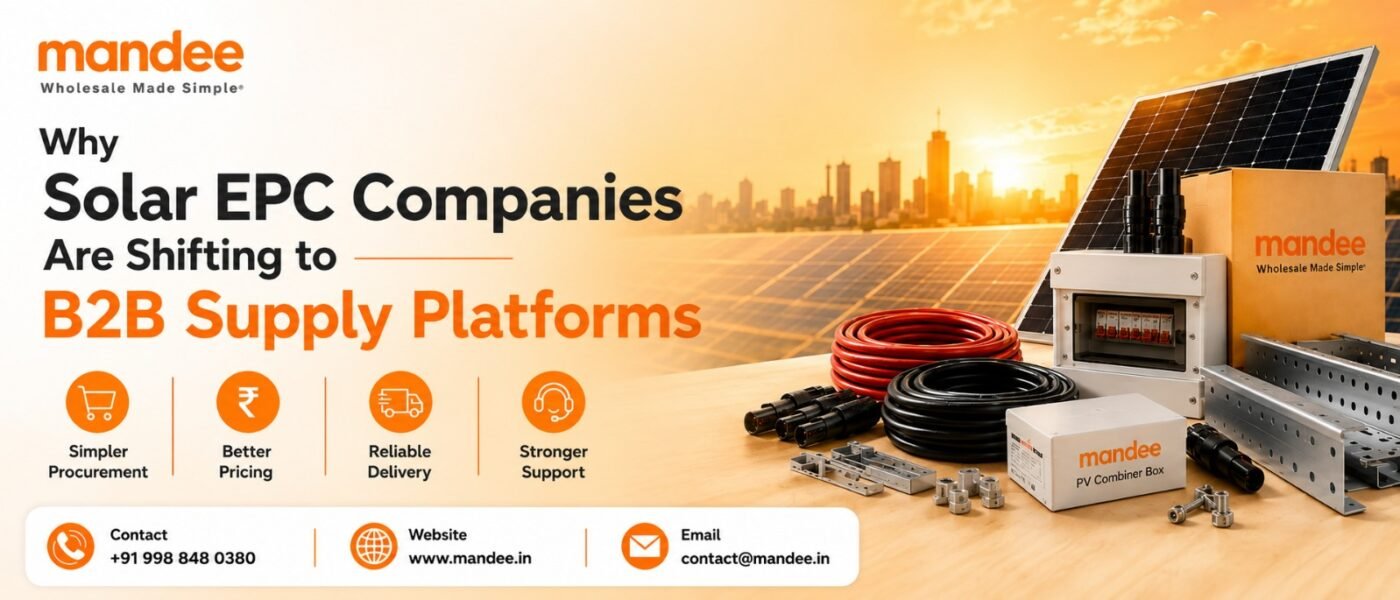
Solar B2B supply platforms are changing how solar EPC companies source modules, inverters, cables, structures, and other project materials. One area that can make a significant difference is procurement. Instead of relying on multiple local vendors, phone calls, and last-minute purchases, more EPC companies are exploring B2B solar supply platforms for sourcing their project materials.
For EPC contractors, the shift is not simply about buying products online. It is about making procurement more organized, transparent, scalable, and predictable. A B2B supply platform can help businesses source solar panels, inverters, cables, ACDB/DCDB units, connectors, earthing products, mounting structures, and other components from a single procurement channel.
For a business like Mandee, which operates as a wholesale solar platform for installers, retailers, and EPC companies, this changing procurement behavior represents an important opportunity.
What Is a B2B Solar Supply Platform?
A B2B solar supply platform is a procurement channel designed specifically for businesses rather than individual residential customers.
Instead of purchasing different materials from several suppliers, EPC companies can use a centralized platform to source multiple solar components according to their project requirements.
These platforms can simplify the procurement of:
- Solar panels
- Solar inverters
- AC and DC cables
- MC4 connectors
- ACDB and DCDB units
- Earthing kits
- Mounting structures
- Junction and protection components
- Other Balance of System (BOS) products
The objective is simple: make solar procurement faster, easier, and more efficient for businesses.
Why Traditional Solar Procurement Can Be Difficult for EPC Companies
Traditional procurement often involves dealing with several vendors for a single project.
An EPC contractor may purchase panels from one supplier, inverters from another, cables from a third vendor, and protection equipment from another. While this approach may work for small orders, it becomes increasingly difficult as project sizes increase.
Common challenges include:
- Different prices from different vendors
- Multiple quotations and negotiations
- Uncertain product availability
- Delivery coordination problems
- Different payment terms
- Inconsistent product specifications
- Delays caused by unavailable inventory
- Difficulty tracking multiple orders
For EPC companies managing several projects simultaneously, procurement can quickly become a time-consuming operational task.
This is one reason businesses are looking for more centralized sourcing solutions.
1. Better Procurement Efficiency
One of the biggest advantages of a B2B supply platform is efficiency.
Instead of spending hours contacting different suppliers, EPC teams can explore multiple product categories through a centralized procurement channel.
This can reduce the time spent on:
- Vendor research
- Product availability checks
- Price comparisons
- Order coordination
- Follow-ups
- Delivery tracking
For an EPC company, saving procurement time means the team can focus more on engineering, installation, project management, and customer relationships.
2. Access to Multiple Solar Products
A solar project requires much more than panels.
Depending on the system design, an EPC company may need:
- Solar panels
- Inverters
- DC cables
- AC cables
- MC4 connectors
- ACDB/DCDB
- Earthing equipment
- Mounting structures
- Protection devices
A B2B platform can bring these categories together under one procurement ecosystem.
Mandee, for example, currently lists solar panels, solar inverters, cables and wiring, connectors and junctions, ACDB/DCDB units, earthing and protection products, and mounting structures.
This makes it easier for EPC buyers to plan procurement around the complete material requirement instead of treating every component as a separate purchase.
3. Bulk Purchasing Can Improve Project Economics
For EPC companies, purchasing quantity matters.
A project requiring hundreds or thousands of units may have very different procurement economics from a small individual purchase.
Bulk procurement can provide opportunities for:
- Better commercial negotiations
- Lower procurement overhead
- Consolidated transportation
- Planned inventory
- More predictable project costing
However, EPC companies should not evaluate suppliers based only on the lowest quoted price.
The right comparison should consider the total procurement cost, including product quality, freight, delivery timelines, availability, payment terms, warranty, and the potential cost of project delays.
For a deeper look at this subject, internally link this section to your earlier article:
4. Faster Access to Ready Inventory
Material availability can directly affect project schedules.
Imagine an EPC company has completed its site preparation and installation team is ready, but a critical component is unavailable. The installation team may have to wait, creating additional operational costs.
A B2B supply platform with available inventory can help EPC companies plan purchases around actual stock availability.
Mandee’s website currently promotes wholesale solar products and provides product categories covering key solar components.
For EPC companies, inventory visibility can make procurement planning much more practical.
5. Reducing Dependence on Multiple Vendors
Managing too many suppliers creates additional administrative work.
Every vendor may have different:
- Pricing structures
- Minimum order quantities
- Delivery schedules
- Payment policies
- Documentation
- Communication processes
A centralized B2B procurement partner can reduce the number of vendor relationships an EPC company needs to manage.
This does not necessarily mean using only one supplier for every project. Instead, it means creating a reliable primary procurement channel and maintaining alternative suppliers when necessary.
6. More Organized Solar Material Procurement
Successful EPC execution starts with proper planning.
Before placing orders, procurement teams should create a detailed Bill of Materials (BOM) covering every required component.
A typical procurement workflow can look like this:
Project requirement → BOM preparation → Product selection → Supplier quotation → Commercial comparison → Order confirmation → Dispatch → Delivery → Site inventory
B2B supply platforms can make this workflow easier to manage by bringing products and procurement information into a more structured environment.
This is particularly useful for EPC companies handling multiple projects at different locations.
7. Easier Vendor Comparison
Choosing a supplier only because they offer the cheapest price can create problems later.
A better vendor evaluation should consider:
Product Quality
Are the products suitable for the project specifications?
Availability
Is the required quantity actually available?
Delivery
Can the supplier deliver according to the project schedule?
Commercial Terms
Are the payment and pricing terms suitable?
Support
Can the supplier respond quickly when there is an issue?
Consistency
Can the supplier support future projects as well?
B2B platforms can simplify this evaluation by giving procurement teams a more structured way to assess their sourcing options.
8. Procurement Becomes More Scalable
A small EPC company may manage procurement manually for a few projects.
But as the company grows, the same approach becomes difficult to maintain.
Suppose an EPC contractor moves from handling five projects to twenty projects. The number of purchase orders, supplier conversations, deliveries, and inventory requirements can increase significantly.
A structured B2B supply model can support this growth by making procurement more repeatable.
This allows the EPC company to develop standard purchasing processes instead of reinventing its procurement strategy for every project.
9. Better Inventory Planning for Large Solar Projects
Inventory management is another important reason EPC companies are exploring B2B procurement platforms.
Buying too little can create shortages.
Buying too much can tie up working capital and increase storage requirements.
The ideal approach is to match inventory with the project’s:
- Installation schedule
- Material consumption
- Delivery lead time
- Project size
- Cash-flow requirements
This becomes particularly important for large commercial and utility-scale projects.
You can also internally link this section to your previous article:
10. Better Control Over Balance of System Components
Solar panels usually receive most of the attention, but EPC companies also need a large number of supporting components.
These Balance of System (BOS) components can include:
- Cables
- Connectors
- ACDB
- DCDB
- Earthing systems
- Protection equipment
- Mounting components
Missing even one critical component can affect installation progress.
A B2B supply platform that offers multiple BOS categories can help EPC companies consolidate procurement and reduce the risk of overlooking smaller but essential components.
11. Digital Procurement Saves Time
Solar procurement is gradually becoming more digital.
Instead of relying entirely on offline vendor networks, EPC teams can use digital platforms to:
- Browse products
- Check specifications
- Compare options
- Request quotations
- Place orders
- Maintain procurement records
Digital procurement doesn’t eliminate the need for professional vendor relationships. Instead, it makes those relationships easier to manage.
For growing EPC companies, this combination of technology and supplier support can become a significant operational advantage.
12. B2B Platforms Support Project-Based Purchasing
Solar procurement is rarely identical from one project to another.
A commercial rooftop project may require a different combination of products from a larger industrial or ground-mounted project.
A B2B supplier can support project-specific procurement by helping businesses source the appropriate combination of materials according to their requirements.
This makes the procurement process more flexible than simply purchasing standardized consumer solar kits.
13. Why EPC Companies in Odisha Can Benefit
Odisha has an expanding requirement for solar solutions across residential, commercial, industrial, and infrastructure applications.
For EPC contractors operating in areas such as Berhampur, Ganjam, and other parts of Odisha, procurement efficiency can become an important competitive advantage.
Local and regional sourcing can potentially help businesses improve coordination, reduce unnecessary logistics complexity, and respond more quickly to project requirements.
EPC companies searching for a solar supplier in Odisha, bulk materials, or project-specific procurement should evaluate suppliers based on product range, availability, delivery capabilities, pricing, and reliability.
14. B2B Platforms Can Help EPC Companies Protect Margins
Profitability is one of the biggest concerns for EPC businesses.
A project can appear profitable at the quotation stage but become less profitable when unexpected procurement and logistics costs appear.
Consider the hidden costs associated with:
- Emergency purchases
- Multiple shipments
- Material shortages
- Project downtime
- Vendor replacement
- Excess inventory
- Procurement delays
A structured procurement strategy helps EPC companies identify these costs earlier.
The goal is not simply to purchase materials cheaply. The goal is to control the total cost of project procurement.
15. What EPC Companies Should Look for in a B2B Solar Supplier
Before partnering with a B2B solar supply platform, EPC companies should evaluate several factors.
Product Range
Does the supplier offer the major products required for your projects?
Wholesale Capability
Can the supplier handle bulk and recurring requirements?
Product Authenticity
Are products sourced through reliable channels?
Availability
Can the supplier consistently provide required quantities?
Delivery Network
Can materials reach project locations within the required timeframe?
Commercial Support
Does the supplier understand the requirements of EPC businesses?
After-Sales Support
Is there a process for handling product-related issues?
Scalability
Can the supplier support you when your project volume increases?
These questions can help EPC companies move beyond simply comparing prices.
16. Why Mandee Fits the B2B Solar Procurement Model
Mandee is positioned as a wholesale solar platform designed to make bulk buying easier for businesses across India. Its website specifically identifies installers, retailers, and EPC companies as customers and provides multiple solar product categories.
The platform currently includes categories such as solar panels, solar inverters, cables and wiring, connectors, ACDB/DCDB units, earthing and protection equipment, and mounting structures.
For EPC companies, this type of centralized sourcing model can help simplify the process of finding and purchasing the components required for solar projects.
17. The Future of Solar Procurement Is More Connected
The solar EPC industry is becoming more professional and competitive.
As project sizes increase, procurement cannot remain dependent entirely on informal vendor networks and last-minute purchasing.
EPC companies increasingly need:
- Reliable suppliers
- Transparent procurement
- Faster product sourcing
- Better inventory planning
- Competitive bulk pricing
- Consistent product quality
- Scalable supply chains
B2B supply platforms can bring these requirements together into a more organized procurement ecosystem.
The companies that build efficient procurement processes today can be better positioned to manage larger project volumes tomorrow.
Conclusion
The shift toward B2B supply platforms is not simply a change in where EPC companies purchase solar materials. It represents a broader change in how businesses approach procurement.
Instead of managing multiple suppliers for every component, EPC companies can use centralized B2B procurement channels to simplify sourcing, improve inventory planning, access multiple product categories, and support project execution.
For growing EPC contractors, the biggest advantage is control—better control over purchasing, inventory, delivery, project costs, and supplier relationships.
As India’s solar market continues to expand, efficient procurement will become just as important as engineering and installation. EPC companies that adopt smarter sourcing strategies can improve operational efficiency while building a more scalable business.
For businesses looking for a reliable B2B solar supply partner, Mandee provides a wholesale platform covering a broad range of solar products for installers, retailers, and EPC companies.
Explore Mandee’s wholesale solar products and streamline your next solar project procurement.